
BPO vs BPM: Key Differences, Examples and How to Choose
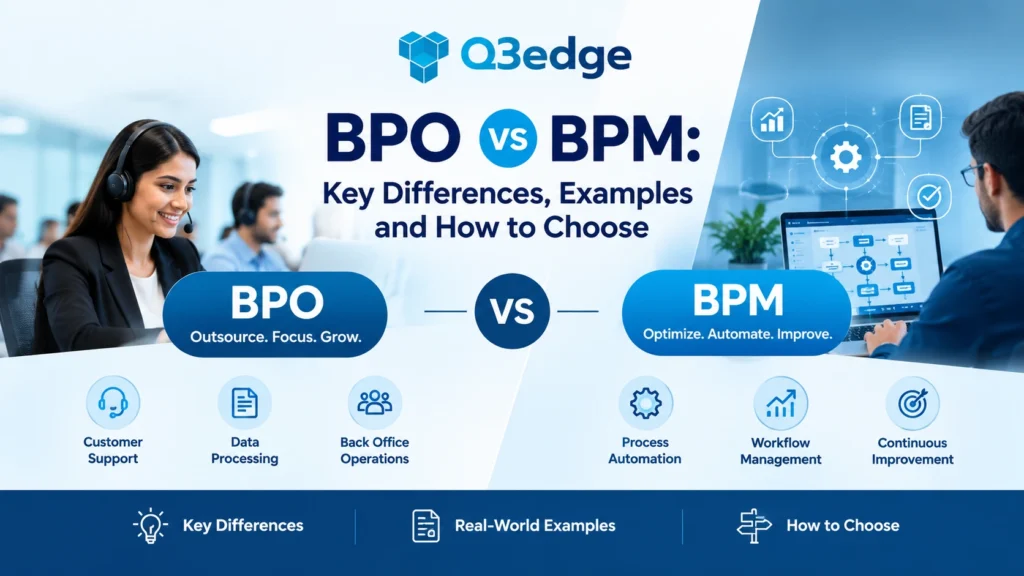
BPO (business process outsourcing) hands a process to an outside provider to run, while BPM (business process management) is the discipline of designing, measuring and improving that process. In short, BPO decides who does the work, and BPM decides how the work gets done. Most businesses need both, in the right order. At Q3edge, a BPM consulting firm that works with enterprises on process improvement and automation, this is one of the questions we hear most often, so this guide explains the difference in plain terms, with real examples and a clear way to decide.
What Is BPM (Business Process Management)?
Business process management is a management discipline for discovering, modelling, improving and monitoring how work flows through an organisation. A business process is a connected series of steps that produces a result, such as onboarding an employee, approving an invoice or resolving a customer complaint.
BPM looks at the process from start to finish instead of fixing one task at a time. A typical BPM cycle has five stages:
- Discover: document how the work is actually done today, not how people assume it is done. Business process mapping is the usual starting point.
- Analyse: find delays, rework, duplicate approvals and unclear ownership. Process mining uses system data to show where work really waits.
- Redesign: remove unnecessary steps, simplify approvals and assign clear owners. This is the focus of business process re-engineering.
- Automate: hand repetitive steps to software, using robotic process automation or business process automation.
- Monitor and improve: track measures such as turnaround time, error rate and cost per transaction, then repeat the cycle.
BPM is an ongoing practice rather than a one-time project, and the knowledge it creates stays inside your organisation.
A simple example: invoices keep getting stuck before payment. BPM would map the invoice journey, show where invoices wait, remove a duplicate approval and route the rest automatically, then track how long approval takes from that point on.
A real-life example: hospital patient discharge. Discharge looks like one step, but it involves doctors, nurses, the pharmacy, billing and insurance, and a delay in any of them keeps the patient waiting. Q3edge worked on this process with a leading hospital in North India, and the hospital now completes discharge for more than 85% of its patients within four hours.
How Q3edge Approaches BPM: The BPM STEP™ Model
The five stages above describe the general cycle. At Q3edge we organise the journey into our four-phase BPM STEP™ model:
- Design and Map: capture how the process runs today and design the improved version.
- Business Intelligence: measure performance with dashboards, analytics and process mining, so decisions rest on data.
- Robotic Process Automation: automate repetitive, rule-based steps.
- System Integration and Workflow: connect your systems and route work automatically between people and applications.
The order is deliberate. Automation and integration come after the process has been understood and simplified, so you automate a good process instead of a messy one.
Measuring Results with TEA™
We judge our BPM work against three objectives, which we call TEA™:
- Transparency: clear roles and responsibilities, a visible link between strategy and execution, and process KPIs that everyone can see.
- Agility: the ability to manage change.
- Efficiency: better processes and stronger people capabilities.
When you monitor a process, these make a practical check. Can everyone see how it performs? Can it adapt when the business changes? Is it getting faster and cheaper to run?
BPM and Lean Six Sigma
BPM works well alongside Lean Six Sigma. Lean removes waste and unnecessary steps, and Six Sigma reduces variation and errors. BPM adds the end-to-end view and the ongoing management that keeps those improvements in place. Our team includes Lean Six Sigma Black Belts, so our consultants can apply these methods alongside BPM.
What Is BPO (Business Process Outsourcing)?
Business process outsourcing is the practice of contracting an external service provider to carry out a specific business function on your behalf. The provider supplies the people, the management and usually the tools, and you pay under an agreed contract, often per transaction, per seat or per full-time employee.
Companies usually outsource work that is repetitive, well defined and not a source of competitive advantage. Common examples include:
- Customer support and call centres
- Finance and accounting, such as accounts payable and payroll
- Data entry and document processing
- HR administration
- IT helpdesk and technical support
- Medical billing and insurance claims processing
BPO can be onshore (the provider works from your own country), nearshore (a neighbouring country) or offshore (a distant country, often chosen for lower labour costs or round-the-clock coverage). Businesses turn to BPO to cut costs, scale up quickly, reach skills they cannot hire easily and free their own teams to focus on core work.
A real-life example: medical billing. A clinic or hospital must turn each treatment into correctly coded claims for insurance companies, and the coding rules are complex and keep changing. Instead of hiring and training a full billing team, many healthcare providers hand this function to a specialist billing company. The provider’s own staff focus on patients, while the BPO partner handles coding, claim submission and follow-up for an agreed fee per claim or per month.
Another everyday example: an online store that receives customer calls, chats and emails around the clock outsources its customer support to a call-centre provider. The store gets trained agents and 24×7 coverage without building its own support centre.
BPO changes who performs the work. It does not, by itself, change how the work is designed.
BPO vs BPM: Key Differences
The two are often compared as if you must pick one, but they answer different questions. BPM asks how a process should work. BPO asks who should run it.
| Factor | BPM | BPO |
| Full form | Business Process Management | Business Process Outsourcing |
| What it is | A management discipline for improving processes | A delivery model that hands work to an external provider |
| Core question | How should this work be done? | Who should do this work? |
| Scope | Entire, end-to-end processes across teams | Specific functions or tasks, such as support or payroll |
| Who owns it | Your internal teams, often with a consultant | The provider runs it; you keep oversight |
| Main goal | Efficiency, consistency, visibility and control | Lower cost, scalability, specialist skills and coverage |
| Cost model | Internal time, tools and consulting fees | Per transaction, per seat or per employee, under a contract |
| Role of technology | Process mining, workflow tools and automation to redesign the work | Whatever tools the provider uses to deliver the service |
| Time frame | Continuous improvement | Contract term, usually fixed |
| Main risk | Mapping and documentation that never changes how work is done | Handing over a broken process and losing visibility into it |
| Where knowledge sits | Inside your organisation | Increasingly with the provider |
A useful rule of thumb: BPM improves the process, BPO runs it. They sit at different layers, which is why they combine well.
How BPM and BPO Work Together
In our view, BPO is not a rival to BPM. Deciding whether to outsource a process is itself a BPM decision, and the strongest results come when the two are used in the right order.
Before you outsource, use BPM. Map the process, remove steps that add no value, define who owns each stage and set measurable targets. Then hand over a process that is clear, stable and documented.
After you outsource, keep using BPM. Track the provider against agreed measures, review recurring delays and exceptions, and update the workflow as your business changes. Keep the process documentation in your own systems so you can switch providers, automate a step or bring the work back in-house without starting from zero.
The order matters because outsourcing a broken process does not fix it. It simply moves the same waste to someone else, under a contract that can make changes slower and costlier. The savings you see in the first year may come only from cheaper labour, while the underlying inefficiency stays hidden.
Take invoice processing. A BPO provider can handle invoice capture and data entry. BPM improves the approval route, exception handling, payment scheduling and reporting around it. Some providers also offer business process services, which add ongoing improvement and automation on top of the outsourced work.
A real-life example from the outsourcing industry: process work pays off for BPO firms too. Q3edge worked with a payroll outsourcing company that cut its costs by 70% and shortened its cycle time by a third.
BPO vs BPM in the Indian Context
India is one of the world’s largest outsourcing destinations, so many Indian enterprises sit on both sides of this topic: some provide BPO services, some buy them, and many do both. The principle is the same in every sector. Understand and fix the process first, then decide who runs it. Here is how that looks in practice:
- NBFCs and lenders: a loan journey passes through application, KYC checks, credit assessment, approval and disbursal, often across several teams and systems. BPM shows where applications wait and which checks are repeated. Only then does it make sense to outsource back-office work such as document verification or collections follow-up.
- Insurance: policy issuance, claims and onboarding all carry compliance steps. Those controls must be built into the process design, whoever runs the work. One of India’s top insurers reduced its customer acquisition time by more than 50% in a Q3edge engagement.
- GST and finance operations: invoice matching, input tax credit reconciliation and return filing are repetitive and rule-based, so they suit automation and, once stable, outsourcing. Because errors can mean penalties or lost credit, the process needs clear checks before anyone else runs it.
- Healthcare: discharge, billing and insurance claims involve many handovers between clinical and administrative teams, as the hospital example above shows.
- Manufacturing: procure-to-pay, inventory and plant reporting run across many systems. A leading Indian aluminium manufacturer improved its operational efficiency by more than 50% in nine months working with Q3edge.
When to Choose BPO, BPM, or Both
Start with the state of the process, not the label. If you cannot describe a process step by step, no sourcing decision will help yet.
Choose BPM first when:
- Work is delayed, repeated or full of errors
- Teams follow different procedures for the same task
- Roles and approvals are unclear
- You are considering automation and want to know what to automate
- You need visibility into how a process really performs
Choose BPO when:
- The process is stable, repeatable and well documented
- Your team is overloaded or you need to scale quickly
- The work needs specialist skills or extended coverage that you cannot build in-house
- The function is non-core and does not set you apart from competitors
Use both when:
- You want to outsource, but the process is still messy. Fix it first, then hand it over
- You already outsource and want better results from the provider
- You are planning to automate part of the outsourced work
Keep strategic work in-house: anything that depends on judgement your business is known for, touches your core differentiation or still changes every week.
Common Mistakes to Avoid
- Treating BPM and BPO as alternatives. One improves the process and the other runs it, so choosing between them is a category error.
- Outsourcing a process you cannot explain. If nobody inside can describe the steps and exceptions, a service-level agreement will only hide the problem.
- Letting process knowledge leave the building. Keep the documentation in your own systems, whoever runs the work.
- Judging BPO by the headline rate. Management time, transition effort and change requests all add to the real cost.
- Turning BPM into paperwork. Process maps that never lead to a change in how work is done are overhead. Tie every mapping effort to a specific problem and a measurable result.
How to Get Started
You do not need a large programme to begin. Start narrow and let the results guide the next step.
- Pick one process that costs disproportionate time or causes repeated errors, such as invoice approval, onboarding or order handling.
- Map it as it really runs. Include the exceptions and the workarounds, not just the official steps. Our guide to business process mapping explains how.
- Measure it. Record turnaround time, error rate and cost per transaction so you have a baseline.
- Fix before you hand over. Remove obvious waste and clarify ownership. Automate steps that are stable and repetitive.
- Decide who runs it. Keep it in-house, automate it, or outsource it, and keep tracking the same measures afterwards.
If you want an outside view of where your processes stand, the BPM assessment is a good first step. You can also read about our BPM services, or build in-house skills with our BPM training for SME practitioners and leadership teams.
Our technology partners. Process work is easier with the right platforms, so Q3edge works with three partners. Software AG provides ARIS, which is used to model processes, analyse them and track their KPIs. GBTEC offers the BIC suite for process design, low-code process execution, process mining and risk management. AutomationEdge provides hyperautomation, combining robotic process automation with AI and intelligent document processing. Together they let us support mapping, measurement and automation on established platforms, so you do not have to piece tools together from separate vendors.
Ready to talk it through? Contact the Q3edge team for a conversation about your processes.
What is the main difference between BPO and BPM?
BPO is the outsourcing of a specific business function to an external provider. BPM is the ongoing management and improvement of a complete business process. BPO changes who does the work, while BPM changes how the work is designed and managed.
Is BPM better than BPO?
Neither is better, because they solve different problems. BPM suits processes that are slow, inconsistent or error-prone. BPO suits stable, well-defined work that you want to scale or run at lower cost. Many organisations use both.
Can BPM and BPO be used together?
Yes. BPM can prepare a process for outsourcing by mapping it, simplifying it and setting performance measures. After the handover, BPM keeps tracking the provider and improving the workflow.
Should I do BPM before BPO?
In most cases, yes, even if only a lightweight version. Outsourcing a poorly understood process tends to move the problems to the provider without solving them.
What is the difference between BPO and BPMaaS?
BPMaaS (BPM as a service) delivers BPM software through the cloud on a subscription basis, so your own teams can design and manage workflows without buying infrastructure. BPO delivers people and services to run the work for you.
Conclusion
BPO and BPM are not competing choices. BPM improves how a process works, and BPO decides who runs it. Outsourcing a process you have not first understood only moves its problems to someone else, while a process that has been mapped, simplified and measured is easier to run well, whether your own team or a partner runs it.
So start with BPM, decide what to keep, automate or outsource, and keep measuring the results. Q3edge brings together our BPM STEP™ model, our TEA™ focus on transparency, agility and efficiency, and partnerships with Software AG, GBTEC and AutomationEdge to help enterprises do exactly that. If you would like help mapping and improving your processes before you decide, get in touch with the Q3edge team.