
Business Process Reengineering Challenges: Why BPR Projects Stall and How to Fix Them
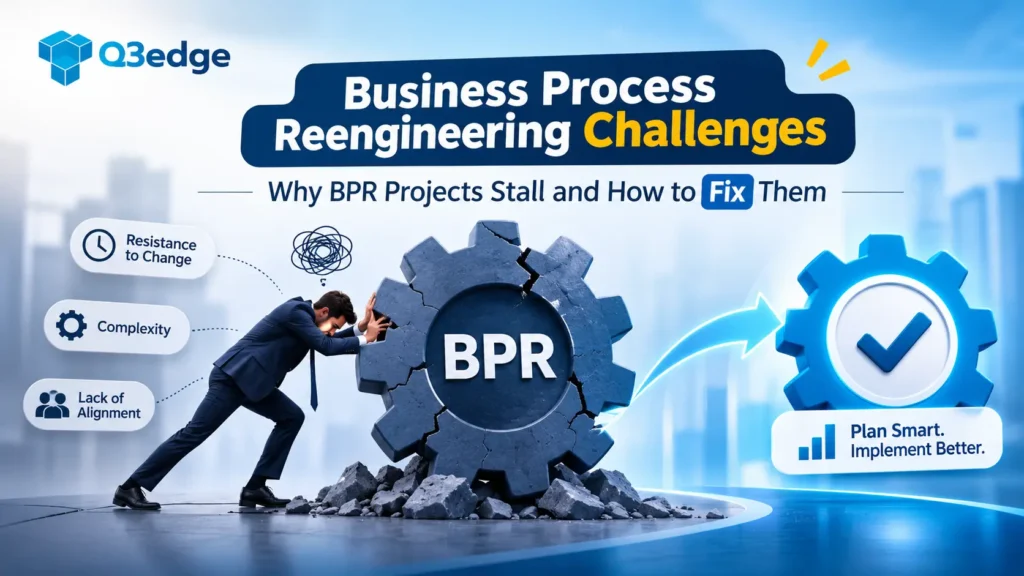
Most leadership teams do not fail at business process reengineering because the idea is wrong. They fail because the project quietly breaks somewhere between the workshop room and the shop floor. The process was never measured. The sponsor lost interest. Teams feared for their jobs. Or a bot was switched on before the workflow underneath was fixed.
If you are a CXO, COO or transformation head weighing a BPR programme, or reviewing one that has stalled, this guide covers the nine challenges that matter most, the early-warning sign of each, the risks specific to India, and the questions to ask before you hire business process reengineering consultants.
Short answer: the biggest business process reengineering challenges are unclear baselines and root causes, weak sponsorship, employee resistance, change management treated as an afterthought, automating before redesigning, scope confusion, siloed ownership, legacy systems and poor data, and unrealistic timelines. Almost all of them show warning signs early, and almost all are preventable.
Business process reengineering meaning in simple terms
Business process reengineering (BPR) is the fundamental rethinking and radical redesign of how work flows from start to finish, aimed at a step change in cost, speed, quality or customer experience rather than a small gain. The idea was popularised by Michael Hammer’s 1990 Harvard Business Review article, “Reengineering Work: Don’t Automate, Obliterate.”
The difference from ordinary process improvement is the starting point. Improvement fine-tunes what exists. Reengineering asks whether the process should exist in its current form at all.
| Phase | Process improvement | Business process reengineering |
| Starting point | The existing process | The customer outcome, often a blank sheet |
| Scope | A task or one department | End-to-end, cross-functional |
| Size of change | Incremental | Radical |
| Risk | Low to moderate | High |
| Typical trigger | Delays, rework, errors | Strategy shift, merger, ERP or digital programme, broken operating model |
Want the full definition, method and phases? Read our guide what business process reengineering is and why it is required and five critical business process reengineering steps. This article focuses on what goes wrong, because that is where most of the cost sits.
What does research say about why BPR projects fail?
The best-known studies are from the 1990s, when reengineering was at its peak. They are dated, so treat them as evidence of patterns, not as today’s failure rates. The patterns are remarkably consistent:
- Implementation is the hard part. A 1994 paper in Management Decision reported that more than half of re-engineered projects failed, and argued that implementation, not design, is the core difficulty (Revenaugh, 1994).
- Change management matters most. A field study of 105 organisations rated 64 implementation problems. Change management emerged as central to success, while technology skills and project planning were necessary but not sufficient.
- Six recurring issues. Research across 25 companies identified the radical-versus-incremental nature of the change, performance measures, the impact of IT, human factors, the presence of a process architecture, and the link to strategy
- People fears dominate. A 2020 Delphi-based study in a dairy company ranked scepticism about BPR’s consequences, job-security worries and resistance to employee replacement among the top challenges.
The lesson: BPR rarely fails on the process diagram. It fails on people, ownership, sequencing and governance.
Business process reengineering challenges (and how to handle each)
1. Redesigning a process nobody has measured
Teams often “know” why a process is slow, but that belief is usually partly assumption. Without a baseline of cycle time, rework, cost per transaction and handoffs, you cannot find root causes or prove improvement later. Consultants at Panorama make a similar point for ERP programmes: mapping the current state should happen before software selection, with people close to the process involved.
Fix: baseline first. process mapping for the intended flow process mining to see what actually happens in your systems, then agree 3 to 5 measurable targets.
2. Weak or fractured executive sponsorship
Reengineering cuts across departments, so it needs a sponsor who can settle disputes between them. If one business head withholds support, budget, data and people quietly disappear.
Fix: appoint one accountable executive, secure written agreement from every affected function head on scope and targets, and put the programme on the leadership review calendar.
3. Employee resistance and job-security fear
Redesigning work changes roles, and employees notice. Silence gets filled with rumours, and the people who hold the real process knowledge stop sharing it.
Fix: be honest about what will change. Involve process owners and frontline staff in design workshops, and explain early whether the goal is capacity release, redeployment or growth.
4. Change management treated as an afterthought
A new design that nobody adopts delivers nothing. Training, communication, incentives and performance measures all have to change with the process.
Fix: run change management as a parallel workstream from week one, with its own owner and plan. Align KPIs and appraisal criteria to the new way of working.
5. Automating before redesigning
This is the most expensive mistake in 2026. Bots and ERP workflows faithfully repeat whatever you give them, including waste. Hammer’s old warning applies as strongly to RPA and AI agents as it did to mainframes. Read why in our analysis RPA failure in un-engineered workflows and ERP configurations stagnate without clean process architecture.
Fix: sequence the work: redesign, simplify, then automate. Automating a broken approval chain only makes it fail faster.
6. Confusion about scope: radical or incremental?
Some teams label a small tidy-up as “reengineering”; others attempt a company-wide overhaul in one go. Both create disappointment. The Maull study flagged this ambiguity as a core issue.
Fix: decide up front, per process, whether it needs a redesign or an improvement. Pilot a high-value process end to end before scaling.
7. Siloed ownership and no process architecture
A process that spans sales, operations, finance and IT usually has no single owner, so every function optimises its own slice. See how this plays out departmental silos and middle-management data hoarding.
Fix: assign end-to-end process owners, build business process architecture so every redesign ties back to strategy, and set process governance so changes are controlled afterwards.
8. Legacy systems and poor data quality
A beautifully redesigned process can still be blocked by a legacy application that cannot support it, or by data that is duplicated, incomplete or locked in spreadsheets.
Fix: include a systems and data assessment in the design phase. Decide early what to integrate, replace, or work around, and keep the first release realistic.
9. Unrealistic timelines and no benefit tracking
BPR is often launched with a big-bang deadline, then judged by activity (workshops held, maps drawn) instead of results. Gains also decay when nobody monitors the new process.
Fix: break the programme into phases with measurable outcomes, review benefits monthly against the baseline, and hand the redesigned process to a named owner.
Challenges specific to business process reengineering in India
The nine challenges above are universal. These factors add pressure for Indian organisations:
- Data protection compliance. India’s Digital Personal Data Protection Rules were notified on 13 November 2025 with a phased timeline; full obligations are due by 13 May 2027 (S.S. Rana & Co. summary). MeitY has since discussed shortening some timelines, so confirm current dates with your legal team. Any redesigned process that collects, stores or shares personal data, such as onboarding, KYC, HR or claims, should build consent and retention rules into the design, not retrofit them.
- Approval-heavy decision culture. Multi-layer sign-offs are a common source of delay, and also a source of resistance when redesign removes them. Address decision rights explicitly.
- Mixed maturity across locations. Head office, plants, branches and outsourced partners often run the same process differently. Standardise before you optimise.
- Attrition during long projects. If process knowledge lives in a few people’s heads, losing them mid-project can derail the work. Document as you go.
- Limited bandwidth in mid-sized firms. Few organisations can release their best people full-time. Pick fewer, higher-value processes and avoid a sprawling scope.
Quick reference: challenge, early warning sign and first fix
| Challenge | Early warning sign | First fix |
| No baseline | Different teams quote different cycle times | Measure with mapping and process mining |
| Weak sponsorship | Steering meetings keep getting postponed | One accountable executive, written scope agreement |
| Employee resistance | Process experts stop attending workshops | Involve them in design, communicate openly |
| Weak change management | Training planned “after go-live” | Parallel change workstream from week one |
| Automating too early | Bot or ERP build starts before To-Be design is signed off | Redesign, simplify, then automate |
| Scope confusion | Everything is called “BPR” | Classify each process: redesign or improve |
| Silos | Nobody can name the end-to-end owner | Process owners and architecture |
| Legacy and data | Manual workarounds in the To-Be design | Systems and data assessment up front |
| Unrealistic timeline | Success reported as activities completed | Phased targets and monthly benefit reviews |
A readiness checklist before you start
Answer these honestly before committing budget:
- Can we name the business outcome, such as cost, speed, compliance or customer experience, that this reengineering must deliver?
- Do we have baseline data for the process we want to change?
- Is there one executive sponsor, and have all affected heads signed off on scope?
- Have we told employees what will and will not change?
- Does each process have an end-to-end owner?
- Have we separated “redesign” processes from “improve” processes?
- Do we know which systems and data sources the new process depends on?
- Is there a plan to track benefits for at least 6 months after go-live?
If you answered “no” to three or more, a short assessment before the main programme will usually save time and money. BPM assessment is designed for exactly this stage.
How to choose business process reengineering consultants in India
External help makes sense when you lack neutral facilitation, cross-industry experience or spare capacity. As a buyer, test any shortlisted firm with these questions:
- What do you do before designing? Good business process reengineering consultants start with baselining and root-cause analysis, not with a favourite tool.
- How do you handle change management? It should be part of the scope, not an optional extra.
- Can you show similar work in my industry? Ask for outcomes, the time taken and who owned results on the client side. Verify references.
- How will benefits be measured and who signs them off?
- What happens after go-live? Look for a handover to process owners and a governance model.
- Are you tool-neutral? The recommendation should follow the problem, not the vendor relationship.
Red flags: guaranteed outcomes, a fixed methodology applied identically to every client, no mention of people impact, and pressure to automate immediately. For a longer buyer’s guide, how to choose the right business process consultant.
How Q3edge approaches reengineering
Q3edge is a BPM consulting firm working with enterprises across sectors such as insurance, banking and financial services, healthcare and manufacturing. Our Strategy to Execution Path moves from business process design and alignment, to process performance intelligence, to re-engineering and optimisation, and then to automation. The order is deliberate: we establish what the process should achieve, use data to find where it really breaks, redesign it, and only then automate. Our principles are transparency, agility and efficiency.
If you want an independent view of where your processes stand, explore business process reengineering services or talk to our team.
What are the main challenges of business process reengineering?
The most common are missing baselines and root-cause analysis, weak executive sponsorship, employee resistance, inadequate change management, automating before redesigning, unclear scope, siloed ownership, legacy systems and poor data, and unrealistic timelines.
Why do business process reengineering projects fail?
Research from the 1990s points to implementation rather than design: people issues, weak change management, unclear links to strategy and poor measurement. Early studies reported failure rates above 50 percent, though those figures are old and definitions of failure vary.
What is business process reengineering (BPR) in simple words?
It is a complete rethink of how a process runs from start to finish, so that cost, speed, quality or customer experience improves sharply, not marginally.
How is BPR different from business process improvement?
Improvement makes the current process better in small steps. BPR questions the design of the process itself and aims for a radical change. BPR carries higher risk and effort, so reserve it for processes where incremental fixes will not be enough.
How long does a business process reengineering project take?
It depends on scope. Redesigning one process can take weeks; an enterprise-wide programme can run for many months. Be cautious of any firm quoting a fixed duration before it has assessed your processes.
Should we automate with RPA first and reengineer later?
Usually not. Automation locks in the current design, including its waste. Redesign and simplify first, then automate the steps that remain.
What should I look for in business process reengineering consultants in India?
Look for a baseline-first approach, change management inside the scope, relevant sector experience you can verify, clear benefit tracking, tool neutrality and a plan for handover after go-live.
Conclusion
Business process reengineering delivers its largest gains and its largest failures. The difference is rarely the quality of the new design. It is whether you measured the starting point, secured genuine sponsorship, brought people along, sequenced automation after redesign, and kept governing the process afterwards. Use the checklist above to test your readiness, and treat each challenge as a risk to manage from day one.
If you are planning or rescuing a BPR initiative, speak to Q3edge about a focused assessment before you commit to a full programme.