
Top 10 RPA Applications Transforming the Banking Industry in 2026

Robotic Process Automation (RPA) has become an important part of how modern banks operate. Today, banks use RPA solutions to handle repetitive, rule-based tasks that require high accuracy and speed. Activities such as transaction processing, KYC verification, fraud checks, and regulatory reporting are now commonly automated. This helps banks reduce costs, minimize errors, and improve overall efficiency.
As banking processes become more complex and high in volume, RPA allows banks to use software bots to manage routine work automatically. This frees up employees to focus on serving customers and making strategic decisions. In fact, many financial institutions report clear benefits after adopting RPA—79% experience time savings, 69% see higher productivity, and 61% achieve cost reductions.
Key Takeaways
- RPA is helping banks move away from manual, error-prone tasks toward smarter and more automated operations.
- When combined with AI, RPA enables better risk prediction, real-time compliance monitoring, and quicker decision-making.
- Banks that implement RPA across finance and operational workflows can achieve significantly faster processing times—sometimes up to 80%—along with noticeable cost savings.
- Focusing first on high-impact areas such as KYC, account reconciliation, and loan processing often delivers faster ROI and smoother adoption.
- To scale digital transformation effectively without increasing workforce size, banks need end-to-end automation platforms that connect processes across departments.
In this blog, we explore how RPA is transforming the banking industry by automating high-volume, rule-based tasks and making banking processes faster, smarter, and more compliant.
We also explain how modern RPA solutions—when combined with AI, Generative AI, and Agentic AI—go beyond simple cost reduction. Instead, they become a strategic enabler of digital transformation in banking, supporting everything from customer onboarding and loan processing to fraud detection, regulatory compliance, and customer service operations.
Strategic Shift Toward Automation-First Banking
Industry data shows that nearly 98% of CFOs have already invested in digitization or automation initiatives within their finance functions. This clearly reflects a strong move toward automation-led banking operations. As we approach 2026, banks are under increasing pressure to cut operational costs, strengthen regulatory compliance, proactively manage risks, and deliver highly personalized customer experiences.
In this environment, RPA—especially when combined with AI, Generative AI, and Agentic AI—is no longer viewed as just a cost-reduction tool. It has evolved into a key enabler of digital transformation across banking institutions.
To better understand this shift, let’s explore the top RPA use cases in the banking industry and see how financial institutions are using automation to operate smarter, faster, and more efficiently.
Top 10 RPA Use Cases in Banking (2026)
Below is a concise, actionable list of the top 10 RPA use cases reshaping banks in 2026 — each entry includes what’s automated, the business impact, a KPI to track, and one practical implementation tip.
Quick context: Robotic Process Automation adoption in banking continues to accelerate (now tightly coupled with GenAI/agentic patterns and cloud-native RPA). Leading consultancies and vendors report that KYC, loan/mortgage workflows, reconciliation, AML, and customer-facing automation remain the highest-value targets.
1. Customer onboarding & KYC automation
What: Automate document ingestion (OCR), identity verification, sanctions/screening and customer record creation.
Impact: Cuts onboarding time from days to minutes, reduces manual review costs and false positives.
KPI: Time-to-complete onboarding; % of automated KYC passes.
Tip: Combine RPA with identity-verification APIs and a rules engine; keep an audit trail for regulators.
2. Loan & mortgage processing
What: Automate eligibility checks, document extraction, credit-data aggregation, decision routing and closing docs.
Impact: Dramatically shorter cycle times, fewer exceptions, faster time-to-funds.
KPI: Avg. end-to-end processing time; % of loans fully automated.
Tip: Start with highest-volume loan products and implement staged human-in-the-loop validation for edge cases.
3. AML monitoring & suspicious activity reporting
What: Automate transaction pattern matching, case creation, enrichment, and SAR filing workflows.
Impact: Faster detection, better traceability, lower regulatory risk.
KPI: Time-to-flag + time-to-file; reduction in false positives.
Tip: Use RPA to enrich alerts with external data before escalating to investigators.
4. Transaction & account reconciliation
What: Auto-match transactions across ledgers, notify exceptions, create journal entries.
Impact: Faster month-end close, fewer mismatches, lower reconciliation headcount.
KPI: % of reconciliations auto-matched; reduction in close-cycle days.
Tip: Implement reconciliation bots with configurable tolerance rules and exception dashboards.
5. Compliance & regulatory reporting
What: Gather, validate, transform and submit regulatory reports, keeping full audit trails.
Impact: Reduced reporting errors and audit effort; more consistent regulatory responses.
KPI: Report error rate; time-to-generate regulatory packages.
Tip: Treat reporting pipelines as versioned dataflows — use RPA for extraction and a rules layer for mapping.
6. Fraud detection & real-time transaction monitoring
What: Continuous, rule-based checks and automated case opening when patterns deviate.
Impact: Faster containment of fraud, lower losses, enhanced customer trust.
KPI: Mean time to detect/contain; fraud reduction %.
Tip: Combine RPA with ML scoring — use bots to enrich alerts (customer history, geolocation, device data) before manual review.
7. Customer service automation (chatbots + back-office bots)
What: End-to-end handling of common requests (balances, disputes, payments) by orchestration between conversational AI and RPA back-end bots.
Impact: Higher first-contact resolution, 24/7 servicing and lower call center costs.
KPI: % self-served; average handle time.
Tip: Orchestrate agentic workflows: chat/voice AI handles front end, RPA executes system tasks behind the scenes.
8. Accounts payable & vendor onboarding
What: Invoice capture (OCR), validation, exception handling, vendor payments and master-data updates.
Impact: Faster invoice processing, fewer late fees, better vendor relationships.
KPI: Invoice cycle time; % invoices auto-processed.
Tip: Use validation bots to cross-check PO/GRN and route only exceptions to AP staff.
9. Credit card issuance & servicing
What: Automate eligibility checks, credit limits, card fulfilment, dispute lifecycle and chargeback handling.
Impact: Faster approvals, reduced leakage and improved cardholder experience.
KPI: Time-to-issue; dispute resolution time.
Tip: Pipeline integration between credit bureau checks, RPA eligibility rules and core-banking APIs yields best results.
10. Accounts / lifecycle management (openings, closures, standing orders)
What: Automate account onboarding, periodic reviews, closure workflows (cancel standing orders, transfer balances).
Impact: Removes manual drags, ensures policy compliance for dormant/closed accounts.
KPI: % lifecycle events automated; compliance exception rate.
Tip: Implement scheduled bots for lifecycle events and notifications to customers to reduce manual churn.
Read Also: How BPM Enhances the Efficiency of Digital Marketing Campaigns.
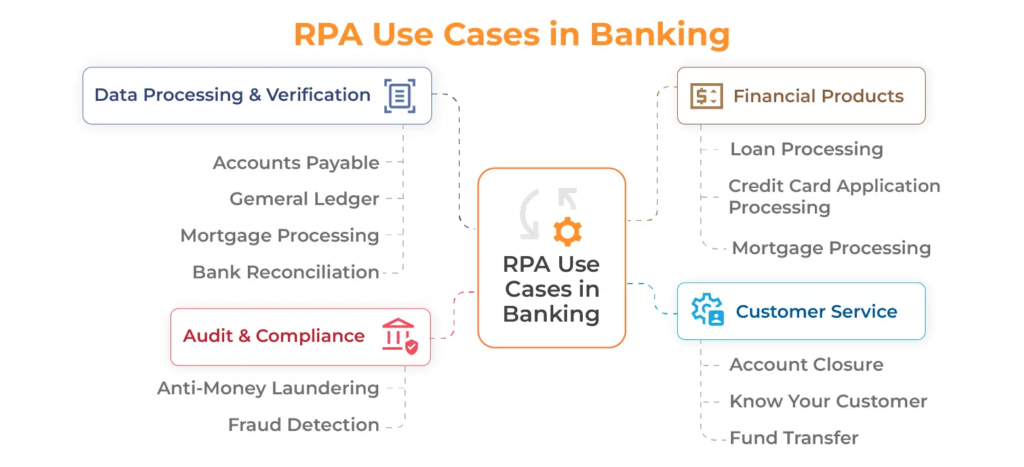
- Financial Products Automation
Loan Processing
Loan processing has traditionally been one of the most time-consuming and complex operations in banking, often taking days or even weeks from application to disbursement.
With RPA and AI-powered automation, banks can dramatically reduce processing time by automating document verification, eligibility checks, and decision workflows. Bots validate customer inputs, flag missing or incorrect information, and generate approval communications automatically. This leads to faster, data-driven lending decisions, fewer errors, and a smoother customer experience.
Credit Card Application Processing
Credit card applications once involved long waiting periods, leading to customer frustration and drop-offs. Managing processing costs and manual verification also placed a burden on financial institutions.
RPA streamlines the entire workflow by automatically collecting customer data, running credit checks, performing background verification, and assessing eligibility based on predefined criteria. What previously took weeks can now be completed in just a few hours, improving approval speed, reducing operational costs, and enhancing customer satisfaction.
Mortgage Processing
Mortgage processing is traditionally a lengthy and labor-intensive process, involving multiple stages such as employment verification, credit analysis, document validation, and property assessment. These steps can take over a month to complete.
RPA transforms mortgage operations by automating repetitive tasks, validating documents through OCR, and enforcing rule-based workflows. By removing bottlenecks and reducing manual errors, banks can cut processing times significantly, improve compliance, and deliver faster approvals. The result is a more efficient operation, lower costs, and a better overall borrower experience.
- Customer Service Automation
Account Closure Process
Banks often face a high volume of account closure requests each month, many of which get delayed due to incomplete documentation or customer non-compliance.
RPA helps streamline this process by continuously tracking closure requests, sending automated reminders for pending documents, and guiding customers through each step. Bots can also handle backend tasks such as cancelling standing orders and direct debits, recalculating interest, and transferring remaining balances through simple digital forms. This reduces delays, lowers operational workload, and improves customer experience.
Know Your Customer (KYC)
KYC is one of the most critical yet complex compliance processes in banking, often involving hundreds of employees to verify customer identities, documents, and risk profiles.
RPA simplifies KYC onboarding by automating data collection, document verification, screening, and validation workflows. By reducing manual effort and errors, banks can complete onboarding much faster, lower operational costs, and maintain compliance standards with greater accuracy.
Fund Transfer Automation
Routine fund transfers between accounts often involve repetitive checks and manual data handling, especially for recurring or scheduled transactions.
RPA enables banks to automate these transfers based on predefined conditions. Bots can verify fund availability, execute transfers, apply charges, and notify customers in real time. This reduces manual intervention, improves accuracy, and ensures seamless transaction processing for customers.
- Data Processing and Verification
Accounts Payable (AP)
Accounts Payable in banking involves repetitive, detail-heavy tasks such as digitizing vendor invoices through OCR, extracting key data fields, and validating entries for accuracy. These manual steps are time-consuming and prone to human error.
With RPA, banks can automate invoice capture, validation, and payment processing end to end. Bots verify invoice details, match them against records, and release payments to vendors only after thorough checks and reconciliation. This not only speeds up processing cycles but also reduces errors and improves vendor satisfaction.
General Ledger Management
Maintaining an accurate general ledger is essential for preparing financial statements, as it consolidates data on revenue, assets, liabilities, and expenses. Traditionally, this process requires gathering large volumes of data from multiple systems, which increases the risk of inconsistencies and delays.
RPA simplifies general ledger management by integrating data from disparate legacy systems and presenting it in a standardized format. Automation reduces manual intervention, improves data accuracy, and significantly shortens reporting timelines.
Mortgage Processing
Mortgage processing is one of the most complex and time-intensive operations in banking, involving multiple steps such as employment verification, credit checks, document validation, and property assessments. Traditionally, these processes can take several weeks to complete.
RPA accelerates mortgage workflows by automating repetitive tasks and enforcing rule-based decisioning. Bots handle document extraction, verification, and workflow routing, eliminating bottlenecks and enabling faster approvals while maintaining compliance.
Bank Reconciliation
Reconciliation is a critical but resource-intensive process that requires comparing high volumes of transactions across systems to ensure accuracy. It is often cited as a major source of errors and delays in financial operations.
RPA streamlines reconciliation by automating data extraction, transaction matching, and discrepancy detection. Bots can quickly compare records from different systems, flag inconsistencies, and trigger alerts for manual review when necessary. This reduces reconciliation time by up to 80%, improves accuracy, and strengthens regulatory compliance.
By automating journal entries, validation checks, and reporting, RPA enhances operational efficiency and allows finance teams to focus on more strategic, value-driven activities.
- Audit & Compliance
Anti-Money Laundering (AML)
Anti-Money Laundering is one of the most data-heavy and compliance-critical functions in banking. It requires continuous monitoring of transactions, screening against watchlists, and detailed reporting—tasks that are traditionally manual and resource-intensive.
RPA simplifies AML operations by automating data collection, screening, case creation, and reporting workflows. Bots can quickly scan large transaction volumes, flag suspicious patterns, and maintain complete audit trails. This reduces compliance costs, improves accuracy, and enables faster response to regulatory requirements.
Fraud Detection
As digital banking grows, fraud techniques have become more sophisticated and frequent, making manual monitoring increasingly impractical. Banks cannot realistically review every transaction in real time without automation.
RPA enhances fraud detection by using rule-based logic to continuously monitor transactions and identify unusual behavior. Bots can instantly flag anomalies, trigger alerts, and route cases to the appropriate teams for investigation. This approach enables faster detection, minimizes losses, and strengthens overall risk management.
Common Mistakes Banks Should Avoid in RPA Adoption
1. Automating Everything at Once
Attempting to roll out RPA across all processes simultaneously often leads to delays, complexity, and poor returns. A phased approach—starting with high-volume, rule-based tasks—delivers faster wins and stronger ROI.
2. Ignoring Process Readiness
Automating inefficient or inconsistent workflows only magnifies existing problems. Banks should first standardize and optimize processes before introducing automation.
3. Overlooking AI Integration
Relying on RPA alone limits automation to repetitive, rule-based tasks. Integrating AI and machine learning enables smarter decision-making, better handling of unstructured data, and more advanced use cases.
4. Underestimating Change Management
Without proper training, communication, and stakeholder alignment, even well-designed automation initiatives can fail. Preparing teams, defining new roles, and ensuring smooth transitions are critical for successful adoption.
Why Banks Choose Q3edge for End-to-End Automation
Modern banks need more than basic task automation. Q3edge delivers a unified automation ecosystem that combines RPA, Generative AI, Agentic AI, Intelligent Document Processing (IDP), and workflow orchestration—purpose-built for large-scale banking transformation.
With Q3edge, banks can achieve:
- Up to 85% reduction in manual effort
- 5–10x faster processing speeds across core operations
- Higher accuracy and stronger regulatory compliance
Key Capabilities of Q3edge
AI-Powered Document Processing
Automate document capture, extraction, and validation for loans, onboarding, mortgages, and credit card applications with high accuracy and speed.
Agentic AI Workflows
Enable intelligent, goal-driven workflows for compliance checks, customer service decisions, and risk analysis—reducing dependency on manual intervention.
RPA-Driven Banking Operations
Deploy bots for high-volume tasks such as reconciliation, fund transfers, account lifecycle management, and regulatory reporting.
Conversational Banking Automation
Deliver seamless customer experiences through AI-powered bots across WhatsApp, email, chat, and IVR channels.
Fraud Detection & AML Automation
Leverage AI signals and rule-based engines to monitor transactions, detect anomalies, and trigger real-time alerts for suspicious activity.
End-to-End Orchestration
Integrate and automate workflows across legacy core banking systems and modern digital platforms, ensuring seamless data flow and operational visibility.
Conclusion
RPA is fundamentally transforming how banks operate. From customer onboarding and lending to fraud detection and regulatory compliance, automation has become essential for delivering speed, accuracy, and scalable growth across financial services.
As RPA converges with AI, Generative AI, and Agentic AI, banks are evolving toward more intelligent, autonomous operations that can make faster, data-driven decisions with minimal manual intervention.
Q3edge enables this transformation by bringing RPA, AI, and agentic automation together in a unified platform—helping banks move from fragmented, reactive workflows to predictive, end-to-end automated operations that improve efficiency, strengthen compliance, and elevate customer experience.