
Cost Savings with RPA in Accounting: Why Enterprises Are Automating Finance

Why Accounting Teams in 2026 Can’t Depend on Spreadsheets Anymore
Accounting teams today are handling far more data, tighter reporting deadlines, and increasingly strict compliance requirements. Despite this, many organizations still rely heavily on spreadsheets for critical financial tasks. According to an Institute of Management Accountants (IMA) report, nearly two-thirds of financial analysts believe that heavy spreadsheet usage not only slows reporting but also increases the chances of inaccurate results.
As accounting standards continue to evolve, spreadsheets have become harder to manage. Complex formulas, interconnected cells, manual data entry, and time-consuming reconciliations create significant risks for finance teams. What once worked as a flexible tool has now become a limitation for modern finance operations.
This is why Robotic Process Automation (RPA) in accounting and AI-driven automation are quickly becoming essential. Instead of depending on manual updates and error-prone spreadsheets, organizations are turning to automation to streamline financial workflows and improve accuracy.
In this blog, we explore how RPA and AI are reshaping accounting operations by automating high-volume, rule-based activities such as accounts payable and receivable, journal entries, account reconciliation, and financial close processes.
You’ll also discover why spreadsheet-driven accounting is becoming unsustainable, how RPA and Agentic AI improve speed and precision, key automation use cases that deliver measurable ROI, and the emerging trends shaping the future of accounting automation.
Key Takeaways from This Article
AI-driven automation helps finance teams complete month-end closing faster while strengthening audit readiness and compliance.
Automated accounts payable and receivable processes improve cash flow visibility and remove operational bottlenecks.
Agentic AI introduces intelligent, self-correcting workflows that reduce manual intervention in accounting operations.
End-to-end automation enables finance teams to scale their processes efficiently without requiring heavy IT involvement.
How RPA and Agentic AI Are Transforming Accounting Workflows
The adoption of Robotic Process Automation (RPA) along with emerging Agentic AI is redefining how modern accounting operations function. These technologies help finance teams automate repetitive, rule-based activities while improving the overall efficiency of end-to-end financial processes. Unlike human work, which can be affected by fatigue, workload pressure, or manual errors, RPA bots perform tasks with consistent accuracy and maintain stable performance throughout the process cycle.
As a result, organizations experience smoother and more reliable accounting operations that support stronger financial governance and operational efficiency.
This transformation enables:
- More predictable and error-free financial outputs
- Standardized and streamlined accounting workflows
- Faster accounting processes and shorter financial close cycles
- Improved accuracy in financial analysis and forecasting
When combined with AI-driven automation, RPA bots can go beyond basic rule execution. They can interpret context, extract information from unstructured documents, and support data-driven decision-making. This allows accounting professionals to shift their focus from repetitive manual tasks to higher-value activities such as financial planning, analysis, and strategic decision support.
How to Unlock Maximum Value from Accounting Automation
Achieving meaningful ROI from accounting automation requires organizations to move beyond simply automating individual tasks. The real value emerges when automation is applied across end-to-end finance workflows. By automating repetitive processes such as accounts payable processing, reconciliation, and transaction validation, companies can significantly improve efficiency, reduce operational costs, and allow finance teams to focus on more strategic work.
Technologies like Robotic Process Automation (RPA) combined with Agentic AI take automation a step further. Agentic AI uses intelligent, autonomous agents capable of reasoning, adapting to changes, and supporting decision-making in real time. For example, these systems can detect unusual transaction patterns, identify potential fraud signals, or automatically apply tax rules during financial processing. This evolution transforms traditional RPA from simple rule-based bots into adaptive automation systems that can reduce financial close cycles by as much as 50% while improving accuracy.
When deployed through orchestration platforms such as AutomationEdge, AI agents function like digital coordinators for finance operations. They intelligently manage tasks across systems, applications, and teams, ensuring that workflows such as month-end closing, accounts payable, and accounts receivable move smoothly without unnecessary delays.
These intelligent agents can also analyze financial ledgers, detect data inconsistencies, and flag unusual transactions that might otherwise go unnoticed. As a result, organizations can accelerate the financial close process by 30–50% while turning month-end activities into faster and more insight-driven operations.
Beyond routine tasks, AI-powered accounting agents are capable of managing complex financial processes such as intercompany eliminations, multi-entity consolidations, and currency conversions. By continuously learning from historical data and integrating with APIs, ERP systems, and automation bots, they help reduce financial risk while improving the accuracy and reliability of accounting operations.
Key Steps to Maximize ROI from Accounting Automation
To fully realize the benefits of automation in accounting, organizations should follow a structured approach:
- Map and analyze existing accounting workflows
- Identify high-volume, rule-based processes suitable for automation
- Integrate automation tools with ERP and financial management systems
- Enhance automation with AI and machine learning capabilities
- Develop a phased roadmap to scale automation across finance functions
Quick Stat: Studies suggest that over 70% of financial reporting errors originate from heavy spreadsheet usage. By automating tasks such as data entry, validation, and reconciliation, Robotic Process Automation (RPA) helps reduce these risks and ensures more accurate and reliable financial processes.
Key RPA Use Cases in Accounting
Accounting teams regularly handle repetitive and detail-oriented tasks that require a high level of accuracy. By adopting Robotic Process Automation (RPA), organizations can automate these routine activities, improve operational efficiency, and lower the overall cost of finance operations. Below are some common ways RPA is transforming core accounting processes.
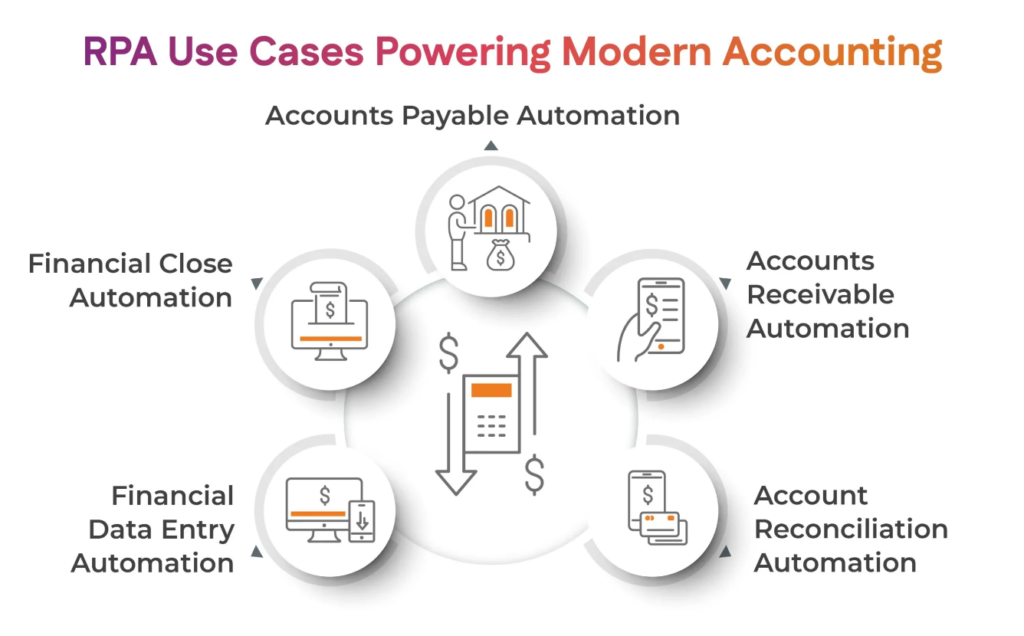
Accounts Payable (AP) Automation
RPA simplifies the accounts payable process by automating invoice intake, data extraction, purchase order matching, and payment processing. Using technologies like Optical Character Recognition (OCR), bots can capture vendor information, invoice values, and due dates directly from documents. This reduces paperwork, minimizes manual effort, and helps ensure that vendor payments are processed on time.
Accounts Receivable (AR) Automation
In accounts receivable, RPA helps automate tasks such as invoice creation, approval routing, payment tracking, and sending reminders to customers. This improves billing accuracy, accelerates the collection cycle, and significantly reduces the need for manual follow-ups.
Account Reconciliation Automation
RPA bots can automatically compare invoices, bank statements, and transaction records during the reconciliation process. Any discrepancies are identified instantly, allowing finance teams to address issues quickly while reducing reliance on spreadsheets and minimizing reconciliation errors.
Financial Data Entry Automation
RPA can extract financial data from multiple sources such as emails, spreadsheets, and legacy systems, validate the information, and update ERP systems in real time. This eliminates repetitive manual data entry and ensures greater consistency and accuracy across financial records.
Financial Close Automation
RPA also supports the financial close process by automating tasks like data consolidation, checklist validation, variance analysis, and report generation. By streamlining these activities, organizations can shorten the financial close cycle while improving the reliability and accuracy of financial reporting.
How Companies Should Approach Accounting Automation
Organizations looking to automate their finance operations should take a structured and phased approach to ensure long-term value. Rather than attempting full-scale automation immediately, companies can begin with targeted improvements and gradually expand automation across accounting workflows.
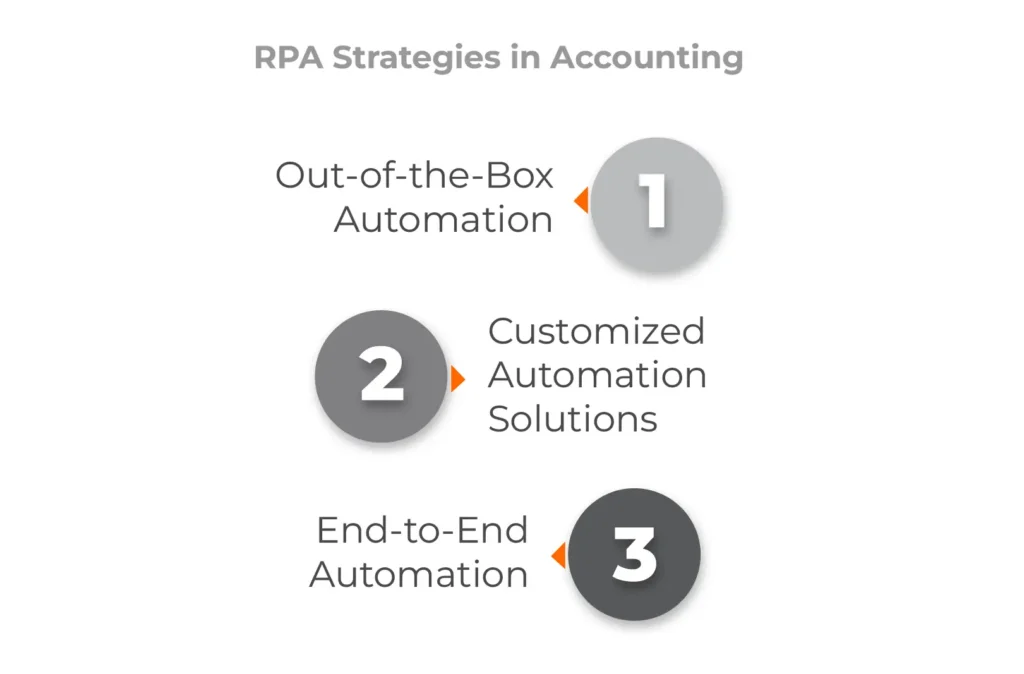
Out-of-the-Box Automation:
Standard automation solutions powered by Robotic Process Automation (RPA) can efficiently handle repetitive, rule-based tasks such as data entry, invoice processing, and reconciliation. When combined with AI capabilities, these systems can interpret data context, assist with decision-making, and even generate automated reports—allowing finance teams to move faster with greater accuracy.
Customized Automation:
For organizations with unique accounting processes, tailored automation solutions offer greater flexibility. Through models like RPA-as-a-Service (RPAaaS), businesses can implement customized automation without large upfront investments. This approach provides scalable automation capabilities while maintaining predictable costs.
End-to-End Automation:
The most successful automation initiatives typically start with small, high-impact processes and gradually expand to broader finance functions. A comprehensive automation strategy often includes readiness assessments, solution design, change management planning, and the creation of a clear implementation roadmap.
Execution Tip: Many organizations achieve the best results by starting with out-of-the-box RPA solutions to secure quick operational wins. Over time, they can introduce AI and advanced automation capabilities to support decision-making and complex workflows. Scaling automation through service-based models and a well-defined roadmap helps maximize ROI while building long-term automation maturity across the finance function.
Benefits of RPA in Accounting
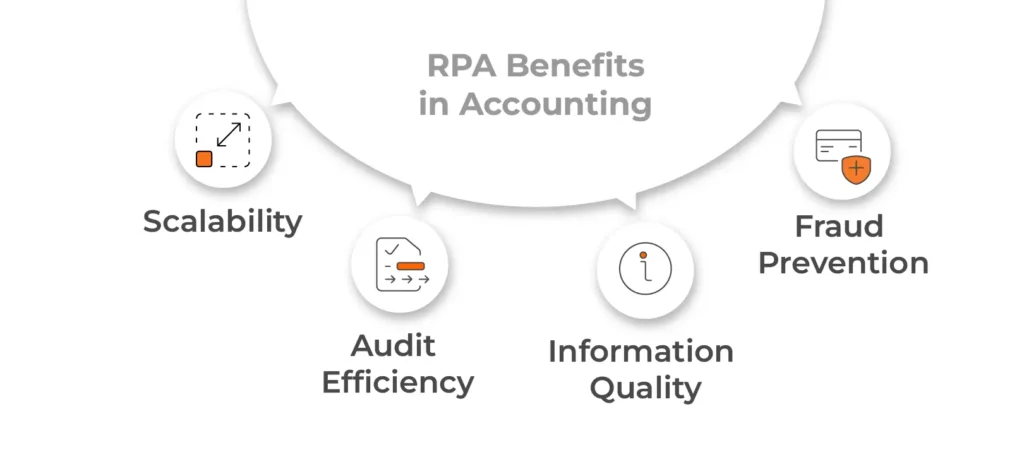
Reduced Fraud Risk:
When combined with AI capabilities, Robotic Process Automation (RPA) can continuously monitor financial transactions and identify unusual patterns or anomalies. This early detection helps organizations strengthen internal controls and improve fraud prevention efforts.
Improved Data Accuracy:
Automation reduces the reliance on manual data entry, which is often the source of errors. By processing financial information automatically and in real time, RPA ensures more consistent, reliable, and accurate financial records.
Faster and More Efficient Audits:
RPA bots can automatically gather, organize, and prepare financial data required for audits. This streamlines the audit process, improves transparency, and allows auditors to access the required information more quickly.
Scalable Finance Operations:
By taking over repetitive and time-consuming accounting tasks, RPA enables finance professionals to focus on higher-value activities such as financial analysis and strategic planning. This also allows organizations to scale their operations more efficiently as the business grows.
Leadership Insight
Finance leaders can unlock greater value from automation by moving beyond simple task automation. By introducing Agentic AI–enabled bots, organizations can create systems that plan actions, support decision-making, and adjust workflows when exceptions occur. This allows finance teams to identify risks earlier, respond more effectively to unusual transactions, and move closer to truly autonomous accounting operations.
How RPA Improves Accuracy in Accounting Processes
Robotic Process Automation (RPA) improves accounting accuracy by reducing manual intervention and ensuring consistent, rule-based execution across financial tasks. Unlike manual processes that can be affected by fatigue or data entry mistakes, RPA bots follow predefined rules and workflows to deliver reliable results every time.
For example, bots can automatically extract invoice details, match them with purchase orders, validate the information, and process payments without the need for manual rekeying. By handling large volumes of repetitive accounting activities, RPA helps organizations maintain cleaner financial data, strengthen compliance, and reduce operational risks. At the same time, it allows accountants to focus on higher-value work such as financial analysis, forecasting, and strategic planning.
Future RPA Trends in Accounting: What’s Next?
The future of accounting automation is rapidly evolving. The next generation of RPA in finance will be influenced by advances in artificial intelligence, agent-driven automation, autonomous workflows, and real-time financial insights. As these technologies mature, finance teams will be able to automate more complex processes, gain faster access to financial intelligence, and operate with greater agility.
Below are some of the key RPA trends that accounting professionals should start preparing for.
Key trends to watch:
| Emerging RPA Trend in Accounting | What It Involves | Business Impact |
| Agentic AI for Accounting Bots | Intelligent bots capable of planning tasks, reasoning through scenarios, taking actions, and automatically correcting errors. | Enables higher levels of automation with minimal manual intervention and smarter financial operations. |
| Hyperautomation in Finance | Integration of Robotic Process Automation (RPA) with AI, OCR, iPaaS platforms, and workflow management tools to automate complex financial processes. | Accelerates end-to-end finance workflows while reducing manual handoffs between systems and teams. |
| Autonomous Financial Close | AI-driven automation of the entire month-end closing process, including reconciliation, validation, and reporting. | Shortens close cycles and improves the accuracy and reliability of financial reports. |
| Predictive Cash Flow Automation | Automation tools that analyze historical data to forecast accounts receivable collections and accounts payable cycles. | Provides improved cash flow visibility and supports proactive financial risk management. |
| Touchless Accounting Operations | Fully automated handling of invoices, receipts, reconciliations, and financial documentation without manual input. | Reduces operational costs while minimizing human errors in financial processes. |
| AI-Powered Risk and Fraud Monitoring | Continuous monitoring of financial transactions using AI to identify anomalies or suspicious activity in real time. | Strengthens fraud detection capabilities and enhances regulatory compliance. |
| Conversational Accounting Assistants | AI-driven chat interfaces that allow finance teams to query financial data and receive instant insights or reports. | Supports faster, data-driven decision-making for finance leaders. |
| RPA-as-a-Service for Small and Mid-Sized Businesses | Cloud-based automation solutions delivered through a subscription model, eliminating the need for large infrastructure investments. | Enables quicker adoption of automation and provides scalable solutions for growing businesses. |
| RPA and Blockchain Integration for Audits | Combining automation with blockchain to maintain tamper-resistant financial records and transaction logs. | Improves audit readiness while strengthening transparency and fraud prevention. |
What Makes Q3edge Ideal for RPA in Accounting?
Q3edge is an intelligent automation platform that helps finance teams automate accounting tasks from start to finish. It combines Robotic Process Automation (RPA), generative AI, OCR, machine learning, and IT automation in one platform.
With AutomationEdge, companies can automate common accounting activities such as invoice processing, vendor management, account reconciliation, and financial close. The best part is that these automations work with existing systems, so businesses do not need to redesign their current software.
Key capabilities include:
- Ready-to-use finance bots for accounts payable, accounts receivable, journal entries, reconciliation, and financial close
- AI-powered data extraction from invoices, PDFs, and scanned documents
- End-to-end automation from capturing data to posting it in ERP systems
- Conversational AI that answers finance and accounting queries
- Easy integration with ERP systems like SAP, Oracle, NetSuite, QuickBooks, and Zoho
- Built-in fraud detection and compliance monitoring
Why businesses choose Q3edge for accounting automation:
- Reduces invoice processing time by up to 80%
- Cuts manual work and errors by 70–90%
- Improves reconciliation accuracy
- Speeds up the month-end closing process
- Allows finance automation to scale without heavy IT effort
Will RPA Replace Accountants?
No. Robotic Process Automation (RPA) is designed to support accountants, not replace them.
RPA handles repetitive and rule-based tasks such as invoice matching, payment processing, and data entry.
This allows accountants to spend more time on important activities like financial analysis, planning, and decision-making.
While automation manages routine work, accountants still provide the business knowledge, judgment, and strategic thinking that technology cannot replace.
By using RPA, finance professionals can work more efficiently and focus on creating greater value for their organizations.
Conclusion
RPA in accounting is no longer just a future idea—it has become essential for modern finance teams. As businesses deal with larger data volumes, faster reporting deadlines, and stricter compliance requirements, automation helps simplify and speed up accounting processes.
By automating activities like accounts payable, accounts receivable, reconciliation, and financial close, companies can reduce errors, complete tasks faster, and improve overall efficiency.
When combined with AI and advanced automation technologies, RPA can create intelligent, end-to-end accounting workflows. Platforms like Q3edge help finance teams implement this transformation quickly without disrupting their existing systems.
If your organization wants to reduce manual work, improve accuracy, and modernize accounting operations, automation is the next step toward a more efficient finance function.